Activity

Cheshire Cat by Exploratorium
Course, Subject
Biology/Living Environment, Math, Science & Technology
Grade Levels
Intermediate, Commencement, 6th Grade, 7th Grade, 8th Grade, 9th Grade
Assembly
No assembly required
Content Provider
© Exploratorium
Duration
15 - 25 Minutes
Materials
A handheld mirror, approximately 4 to 6 inches (10 to 15 cm) on a side.
A white wall or other white surface (white posterboard works well).
A partner.
To Do and Notice
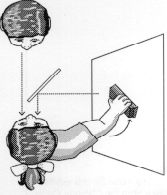
Sit so that the white surface or wall is on your right. Hold the bottom of the mirror with your left hand, and put the mirror edge against your nose so that the reflecting surface of the mirror faces sideways, toward the white surface.
While keeping the mirror edge against your nose, rotate the mirror so that your right eye sees just the reflection of the white wall, while your left eye looks forward at the face of a friend who is sitting a couple of feet away (see diagram). Move your hand in front of the white surface as if passing a blackboard eraser over the surface. Watch as parts of your friend's face disappear.
It will help if your friend is sitting very still against a plain, light-colored background. You should also try to keep your own head as still as possible.
If you have trouble seeing your friend's face disappear, one of your eyes might be stronger than the other. Try the experiment again, but this time switch the eye you use to look at the person and the eye you use to look at the wall.
Individuals vary greatly in their ability to perceive this effect; a few people may never succeed in observing it. You may have to try this several times. Don't give up too soon! Give yourself time to see the effect.
Description
Under most circumstances, both of your eyes receive fairly similar views of the world around you. You fuse these views into a single three-dimensional picture. This activity lets you explore what happens when your eyes receive different images.
Website(s)
Exploratorium - Science Snacks
What's Going On?
Normally, your two eyes see very slightly different pictures of the world around you. Your brain analyzes these two pictures and then combines them to create a single, three-dimensional image.
In this activity, the mirror lets your eyes see two very different views. One eye looks straight ahead at another person, while the other eye looks at the white wall or screen and your moving hand. Your brain tries to put together a picture that makes sense by selecting bits and pieces from both views.
Your brain is very sensitive to changes and motion. Since the other person is sitting very still, your brain emphasizes the information coming from the moving hand, and parts of the person's face disappear. No one knows how or why parts of the face sometimes remain, but the eyes and the mouth seem to be the last features to disappear. The lingering mouth gives rise to the name of this exhibit.
Etcetera
The name for this exhibit derives from the Cheshire Cat in Lewis Carroll's story Alice's Adventures in Wonderland. The cat disappears, leaving behind only its smile.
 Today is Friday, April 3, 2026
 Hello, Guest!